

Did You Know Most Doctors Still Don’t Use EHRs to Their Full Potential?
Clinicians log into the EHR all day, yet features that could save hours and improve care often go untouched. Clunky workflows, rigid templates, and scattered data push physicians to do the bare minimum: record the visit, close the note, move on.
When Documentation Feels Like an Extra Job
Many EHRs make charting slower, not faster: too many clicks, too much typing, and too much hunting for the right place to put information. That’s how you end up with late‑night charting, copy‑paste habits, and notes that feel like they’re written more for the system than for clinical care.
Practices can work significantly faster while producing cleaner, more complete documentation that supports both care and billing.
When “Smart” Features Go Unused
Many physicians ignore alerts, decision aids, and coding helpers because they’re noisy, generic, or poorly timed. That leaves valuable capabilities on the table like better support for medical necessity, fewer denials, and more consistent follow‑up.
WithinEHR builds intelligence directly into everyday workflows. AI‑driven tools help optimize claims, tighten documentation, and surface what actually matters at the right moment, instead of flooding clinicians with low‑value pop‑ups.
Practices using this type of automation have seen meaningful gains in revenue through more accurate coding and cleaner claims.
When the EHR Doesn’t Fit the Specialty
Out‑of‑the‑box EHR setups are often geared toward generic primary care, leaving behavioral health, psychiatry, and other specialties fighting against templates that don’t fit. That’s when clinicians start using workarounds external notes, spreadsheets, separate tools that fragment the record and weaken compliance.
WithinEHR is intentionally built around independent and specialty providers, so workflows and documentation patterns fit the visits they actually run. Charts stay specialty‑sensitive while still sitting on a single, secure backbone, which makes it easier to expand services without multiplying tech headaches.
When Clinicians Don’t Trust the System With the Full Story
Many doctors still rely on memory, side notes, or personal lists because they don’t trust the EHR to surface what matters when it matters. Important context ends up off‑system, making it harder for the rest of the team and any automation to support care.
WithinEHR is built as an AI‑native platform, which means it turns what you document into real‑time insight rather than static text. It can highlight patterns, support more personalized care, and reduce cognitive load by letting the system track details and trends instead of the clinician carrying everything in their head.
When Security and Training Feel Separate From Daily Work
Even powerful EHRs get underused when teams are worried about privacy, unclear on what’s safe, or never fully trained beyond basic use. That’s when advanced features stay untouched, and staff fall back to habits that feel simpler but are riskier.
WithinEHR weaves privacy and security into how the platform is designed and supported. Strong encryption, vetted partners, and practical guidance on data handling make it easier to use more of the system without creating new risks. Training resources and best‑practice content help staff understand how to work safely within the platform, so teams can embrace richer workflows with confidence.
See What Your EHR Could Be Doing for You
Schedule a demo to walk through your real‑world workflows and see how WithinEHR can shift your EHR from “something you have to use” to a platform that actively supports your patients, your team, and your bottom line. Click Here
Frequently Asked Questions:
Q: Why do most doctors underuse their EHRs?
A: Many EHRs are hard to navigate, slow, and poorly matched to real workflows, so clinicians focus on basic charting and ignore more advanced features like automation, analytics, and decision support.
Q: What does it mean for an EHR to be “AI‑native”?
A: An AI‑native EHR is built with AI embedded throughout the platform supporting documentation, coding, and insights rather than adding AI as a bolt‑on tool. This allows automation and intelligence to show up naturally inside day‑to‑day workflows.
Q: How can a system like WithinEHR reduce documentation time?
A: WithinEHR uses features like its AI SOAP Engine and voice automation to structure notes faster and cut down on repetitive data entry, which can significantly reduce the after‑hours documentation burden.
Q: Is it safe to rely on AI inside an EHR?
A: Safety depends on how the platform is built and governed. Strong encryption, role‑based access, clear privacy practices, and staff training are key to using AI‑enabled EHRs securely.
Ready to streamline your practice?
See how Within EHR's AI-native tools can transform your workflow.
Book a demoYou May Also Like

Electronic Health Record Transition and Impact on Screening Test Follow-up
Switching to a new Electronic Health Record (EHR) system is one of the most important and risky transitions a healthcare organization can make.
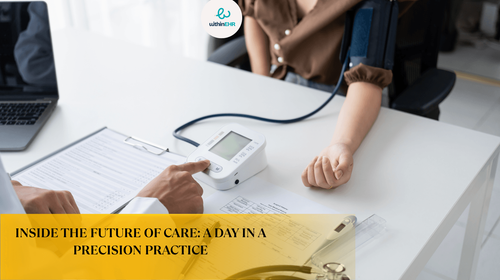
Inside the Future of Care: A Day in a Precision Practice
Healthcare is rapidly evolving toward a model where data, automation, and intelligent digital systems shape everyday clinical decision-making. This shift is transforming traditional offices into what is now known as a precision practice—a modern care environment that leverages integrated technologies to deliver more accurate, efficient, and individualized care.